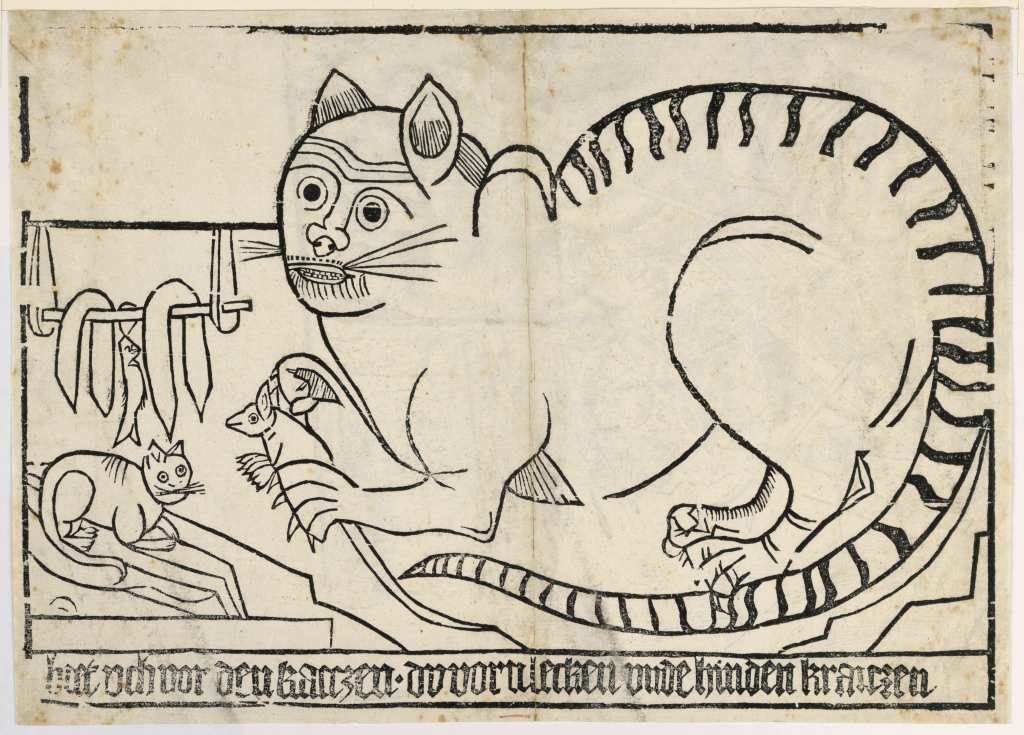
Are these the strings that poets saigne,
Have cleared the Ayer and calmed the mayne,
Charmed wolves and from the mountains crests,
Made forrests dance with all their beasts?
Could these neglected threds you see,
Inspire a Lute of Ivorye
And bid it speake? So thinke then waht
Hath been committed by my catt!
That in the silence of this night,
Hath gnawed these knotts and marr’d them quite,
Sparing such reliques as might bee
For fretts; not for my lute, but mee:
Pusse, I will curse thee; may’st thou dwell
With some dry Hermet in a cell,
Where ratt ne’er peepd, where mouse ne’re fed,
And flyes goe supperlesse to bed.
Or with some close paw’d Brother where
Thoudst fast each sabboth in the yeare
Or else (prophane) bee hanged on Munday
For butchering a mouse on Sunday.
Or mayst thou tumble from some tower
And misse to light upon all foure,
Taking a fall that may untye,
Eight of nine lives and let them flye.
Or may the midnight embers sindge,
Thy dainty coate, or Jane bewindge
Thy hyde, when shee shall take thee byting
Her cheese clouts or her house beshiting.
What was there ne’er a Ratt nor mouse,
Nor buttery ope? nought i’th house
But harmlesse lute strings could suffice
Thy paunch and draw thy glearing eyes?
Did not thy conscious stomache find
Nature phrophan’d that kind with kind
Should staunch its hunger? Thinke on it
Thou canniball, and ciclops catt
For know, thou wretch, that every stringe
Is a catt gutt, wch art doth spinne
Into a thred; And now suppose
Dunstan (Yth snift the Divells nose)
Should bid those guts revive (as once
He raysed a calfe from naked bones)
Or I to plague thee for thy sinne,
Should draw a circle and beginne
To conjure, for I am looke to’t
An Oxford scholler and can do’itt.
Then wth three setts of mops and mowes
Seven of odd names and motly showes
A thousand tricks which might be taken
From Faustus, Lamb or Fryar Bacon,
I should begin to call my strings
My catlings, and my minikins
And they recalld streight should fall,
To mew, to purre, to catterwall
From pusses belly; sure as death
Pusse should bee an engastromyth;
Pusse should be given to the Kinge
Like to some wonder or Rare thing.
Pusse should be sought too farre and neare,
As shee some cunning woman were:
Pusse should be carried up and downe
From shire to shire, from towne to towne,
Like to the Cammell, Leane as Hagge,
The Elephant, or Apish Nagge,
For a strange sight; pusse should be sung
In lowsy ballads, midst the Thronge
At markets, with as good as grace
As Agincourt, or Chevy Chase;
The Troy sprung Brittaine would forgoe
His pedigree hee chaunteth soe,
And singe that Merlin longe deceast
Returned is in a nine liv’d Beast.
Thuse pusse thou seest wt. might betide thee
But I forbeare to hurt or chyde thee,
For’t may bee pusse was melancholly,
And so to make her blyth an jolly
Finding those strings, shee’d have a fitt
Of mirth; well pusse if yt were it;
Thus I revenge mee, that as thou
Has played on them, I’ve plaid on thee now
And as thy touch was nothing fine,
Soe I’ve but scratcht these notes of mine.
Poem by Thomas Master (1603–1643) [bold for emphasis my own]
Contained in: Bodleian Library MS Ashmole 47, f. 24 (An octavo miscellany of verse and some prose, in five hands, one predominating on ff. 8v–130r, ii + 166 leaves (plus blanks), in contemporary calf. Compiled in part (ff. 131v–66r) by Elias Ashmole (1617–1692), astrologer and antiquary. c. 1630s–1640s.
Printed in: La Rue, Hélène. “The Harp That Once”. Journal of Museum Ethnography, no. 2 (1991): 81–88. http://www.jstor.org/stable/40795036.
It appears that this situation is no less common today than it was in the seventeenth century: https://www.hillspet.com/cat-care/healthcare/what-to-do-if-cat-eats-string?lightboxfired=true. La Rue notes: The catastrophe chronicled in the above poem is not among the many normal hazards associated with musical instruments in museums. Even without this, a collection of musical instruments from the moment of its collection or acquisition, to its storage and display, presents us with a whole series of anxieties, frustrations and dilemmas.

 Catterwall
Leave a comment